
Introduction
Picking a tattoo you will still like in ten years is harder than it looks. Most men scroll through hundreds of designs and still feel unsure about size, placement, and style.
A design that looks sharp on a screen can turn blurry, crowded, or awkward once it heals on skin. Weak linework and poor placement are common reasons men regret a piece.
These 20 tattoo ideas for men in 2026 cover bold and subtle styles, with notes on placement, detail, and how each design ages. Use them to choose a style and brief your artist.
What to Check Before You Commit to a Tattoo Design
- Mistake: tiny detail. Fine lines and small text can blur over the years. Ask your artist if the design should be larger or simplified so it stays readable.
- Mistake: choosing placement last. Forearm, bicep, chest, and calf all have different shapes. Pick the spot first so the design can follow the natural lines of the body.
- Mistake: copying a reference exactly. Bring photos for style and mood, then ask for a custom version that fits your size and skin.
- Mistake: ignoring fading. Sun exposure and friction wear tattoos down. Ask your artist about aftercare and plan for touch-ups on areas that see a lot of wear.
Winged Sword Neck Tattoo
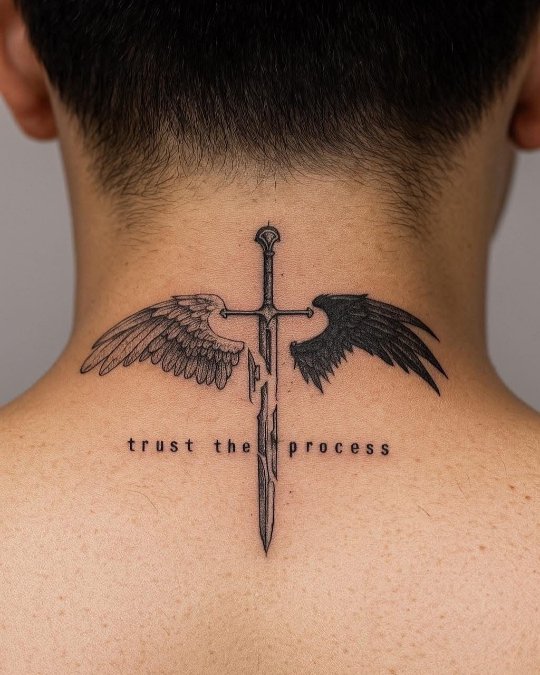
This black ink piece sits at the base of the neck, centered on the upper spine. A sword runs vertically with one light wing and one solid black wing, and the lowercase line “trust the process” crosses the blade. It is one of the more detailed neck tattoo ideas for men who want something personal.
- Why it works: The light feathered wing and the dense black wing create strong contrast. The straight blade keeps the design balanced and follows the line of the spine.
- Ask your artist: Request fine linework and stippled shading on one wing, with a fully filled wing on the other. Ask how wide the lettering should be so the thin type stays readable as it ages.
- Best for: Men with short, tapered hair who want a visible piece. A clean neckline, like the one in this photo, keeps the design in focus.
Maintenance tip: Small text and light shading fade faster than solid black areas. Sun exposure on the neck speeds that up, so plan for a touch-up and use sunscreen once it heals.
Abstract Compass Wings Back Tattoo
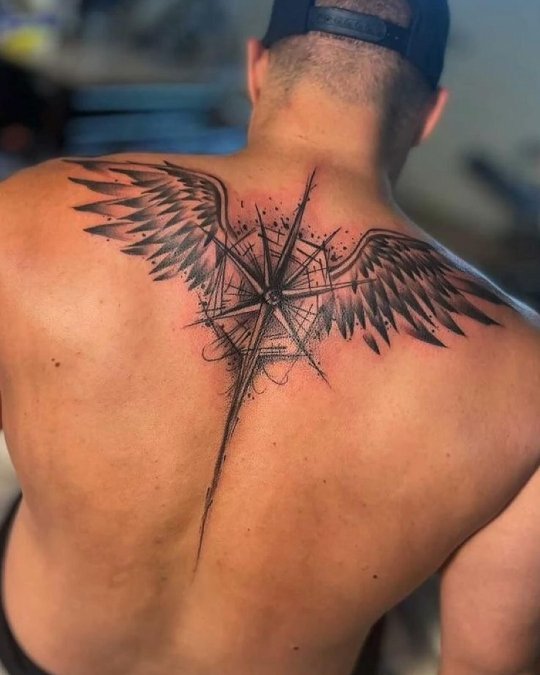
A sharp compass star sits between the shoulder blades, with a wing spreading across each side of the upper back. The black and grey linework looks sketched by hand, with scratchy hatching, small ink splatter dots, and feather tips cut like blades. A thin tapered line runs down the spine and makes the piece look longer.
The design works because the wings follow the slope of the shoulders, while the compass anchors the center of the back. A wide upper back gives wings like these room to spread. The skin looks slightly red around the ink, so this may be a fresh piece.
Make it work: Loose sketch-style lines and splatter fade more softly than crisp outlines. The long spine line is harder to keep even, so pick an artist who has healed sketch work in their portfolio.
Lion and Cross Neck Tattoo
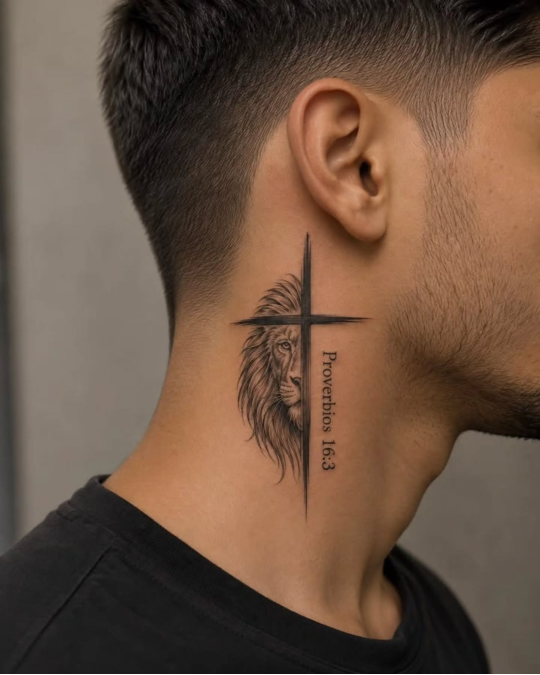
Tattoo formula: half lion face + brushstroke cross + vertical scripture text
The side of the neck holds a tall, thin cross drawn with rough, brush-like strokes. The left half of a lion’s face is shaded into the cross line, with detailed fur and a calm, direct eye. The text “Proverbios 16:3” runs vertically along the right side of the vertical line.
The half-lion effect works because the cross splits the face cleanly and leaves the design looking balanced. Placing it just below the ear and along the neck lets the long vertical shape follow the muscle line. The short tapered fade around the ear keeps the area clean, so the artwork stays the focus.
Ask your artist: Request soft grey shading on the lion with a darker, bolder cross line. Check the spelling and verse before the stencil goes on, since the text is in Spanish.
Maintenance tip: Fine fur detail and thin serif lettering blur sooner than the solid cross. Neck skin moves and sees sun, so expect a touch-up in a few years.
A Realistic Spider Neck Tattoo
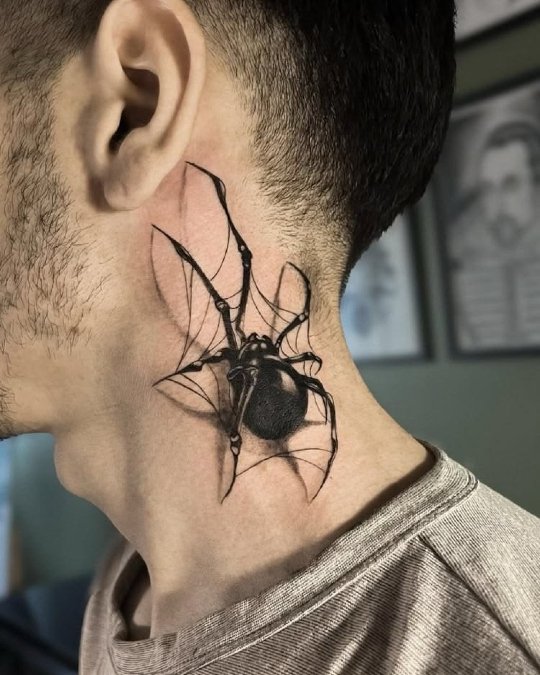
A large black spider sits on the side of the neck, just below the ear. Its round abdomen is packed with solid black ink, and the jointed legs have small highlights that make them look raised. Thin web lines fan out behind it, with soft grey shadow on the skin to add depth.
Why this style works:
- Contrast: The dense black body stands out against the fine web lines, so the eye goes straight to the center.
- Placement: The legs stretch up toward the ear and down toward the collar, following the curve of the neck.
- Shadow work: The grey shading under the spider makes it look like it is crawling on the skin instead of sitting flat.
What to avoid: Keep the web lines from getting too tight or crowded. Thin lines close together can blur into one dark patch as they age.
A short tapered fade and light stubble frame the tattoo well, since neither competes with the design. Neck tattoos are highly visible, so think about work dress codes before booking.
Samurai Silhouette Behind the Ear
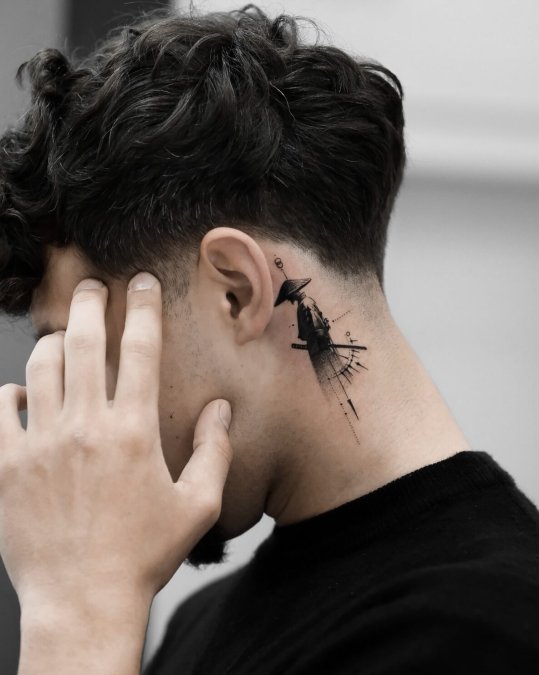
Best for: Men who want a small black ink tattoo that looks sharp without covering much skin.
A tiny samurai in a wide conical hat stands in solid black behind the ear, with a sword line crossing at his waist. Thin dotted lines, small circles, and compass-style tick marks surround him. A soft grey wash fades down from the figure into a fine tapered line.
The design works because the figure is dense black while everything around it stays light and open. That contrast makes a small piece easy to read. Its position follows the curve of the ear and neck.
The wavy, textured top and low taper fade also help. The short, clean neckline keeps the area behind the ear clear, so the tattoo stays in view.
Make it work: Dotted lines and the faded wash soften first as the tattoo ages. Ask your artist to keep the dots well spaced and the figure bold so the silhouette stays clear.
Minimal Latin Quote Tattoo
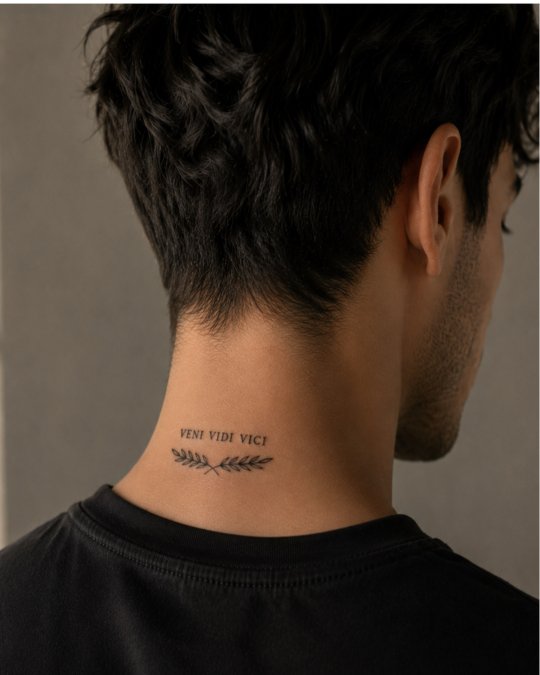
A single line of small capital letters reads “VENI VIDI VICI” at the lower back of the neck. Below it, two thin laurel branches cross at the stem, centered on the spine. The linework is fine and black, with no shading, so the piece takes up very little skin.
Ask your artist:
- Text: Ask for evenly spaced serif capitals. Wider spacing between letters stays legible longer than tight spacing.
- Branches: Keep the leaves simple and slightly apart. Tiny leaves packed together tend to merge as the lines soften.
- Placement: Center it on the spine, just above the shirt collar. That keeps it visible when the collar is down and hidden when it’s up.
- Size: Go a little larger than feels necessary. Fine-line text at this scale needs room to age well.
The tattoo works because the quote and laurel are stacked and centered, so the nape looks balanced. A wavy, textured top with a short, natural neckline leaves the skin clear, so nothing competes with the lettering.
Maintenance tip: Fine lines fade faster than bold ones, especially on the neck, which gets sun and collar friction. Use sunscreen once it heals and plan for a touch-up.
Blackwork Lightning Shoulder Tattoo
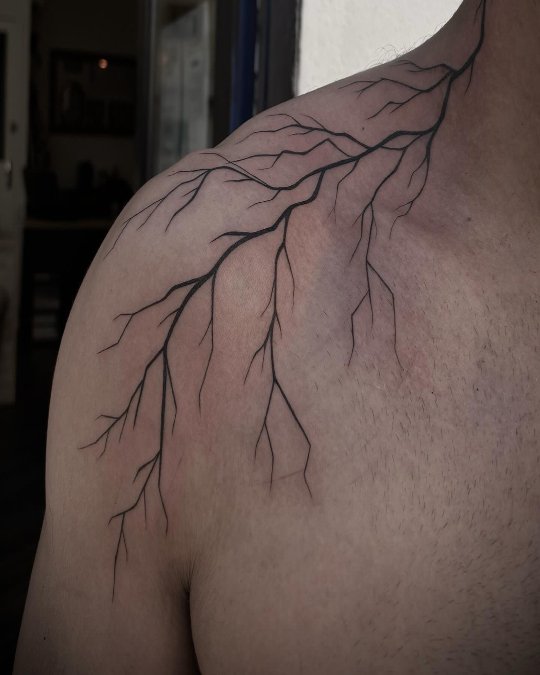
A thin black lightning bolt starts at the side of the neck and runs along the top of the shoulder. From there it splits into many branches that spread across the shoulder cap and toward the chest. The main line is thicker, and the forks get finer toward the ends, so the bolt looks like it is cracking across the skin.
Hair texture tip: The tattoo follows the slope of the neck and shoulder, so it moves with the body instead of sitting flat. That is why it works well on a broader shoulder, where the branches have room to spread.
- Placement: Ask your artist to plan the bolt while you stand relaxed. The stencil should follow the line of the collarbone and shoulder, not sit on the skin as a flat shape.
- Maintenance: The thinnest branches fade first. Keep them from running too close together, and plan a touch-up on the small tips after a few years.
Because the design is open and only a few lines wide, it can be extended later down the arm or across the chest. A tight, short neckline helps too, since the top of the bolt starts right at the neck.
Note: This photo has a tattoo studio watermark in the top left corner. Check the source and credit it, or ask the studio for permission, before you publish it.
Sun and Moon Shoulder Tattoo
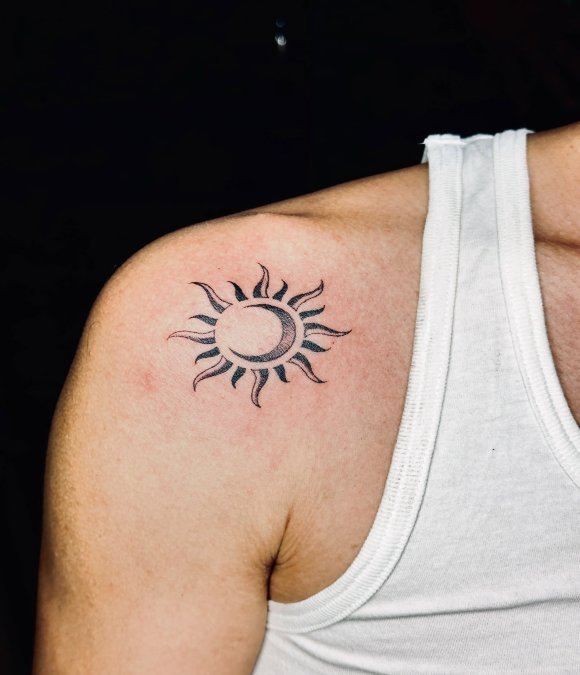
Tattoo formula: sun circle + crescent moon + curved flame rays
A round sun sits on the front of the shoulder, close to the collarbone, with a shaded crescent moon inside the circle. The rays curl like small flames. Some are solid black, and others fade into soft grey at the tips.
The design works because the open center lets the moon stand out. The mix of dark and fading rays adds movement without crowding the circle. The skin looks slightly red, so this may be a fresh photo.
Best for: Men who want a medium-small piece that can be covered by a shirt sleeve.
Maintenance tip: The soft grey rays fade before the black ones, and this part of the shoulder gets a lot of sun. Use sunscreen once it heals, and ask your artist to keep the gaps between rays wide enough to stay clear.
Realistic Tiger Forearm Sleeve
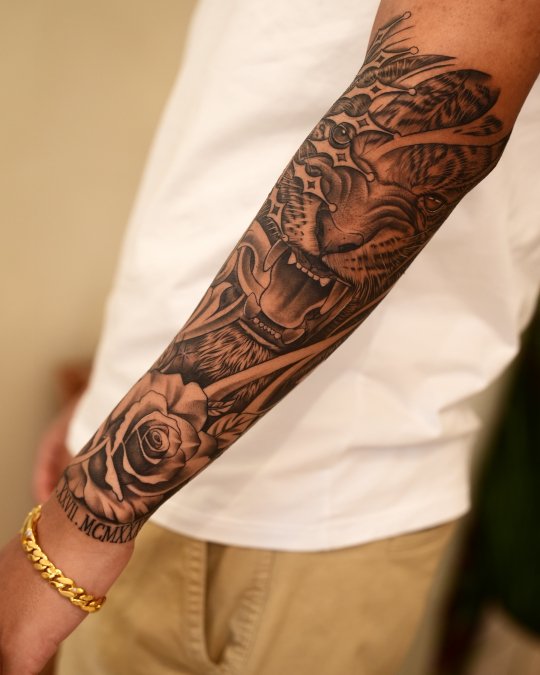
A roaring tiger fills the outer forearm, with open jaws, sharp fangs, and a fierce stare. The stripes are drawn in fine black lines with soft grey shading, so the fur looks layered. An ornate band of diamond shapes and small stars frames the head like a crown.
Near the wrist, a shaded rose with leaves anchors the bottom of the sleeve. A thin band of Roman numerals wraps the wrist edge, though the photo cuts off part of it. The shapes follow the curve of the arm, so the design flows from wrist to elbow instead of sitting in one flat panel.
Make it work: Realistic shading depends on strong dark areas next to light skin. Ask your artist to keep the darkest spots bold, since soft grey fades first on the forearm. Sun exposure and sleeve friction wear it down, so plan sunscreen and a touch-up.
Roman Numeral Clock Sleeve
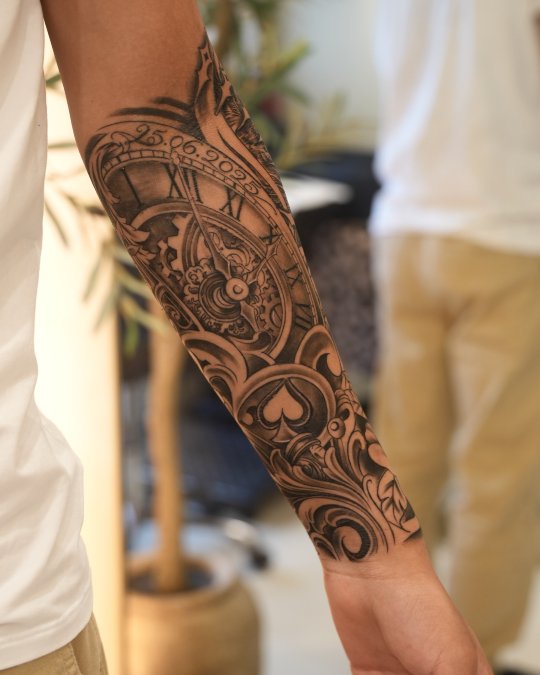
A clock face with bold Roman numerals sits on the forearm, with gears showing behind the hands. A curved band above it carries the date 25.06.2025. Below the clock, a spade symbol sits inside a rounded frame, and curling leaf scrollwork runs down toward the wrist. The shading is black and grey, with soft gradients.
- Personalize it: The date and clock hands are easy to change. Ask your artist to set the hands and date to a moment that matters to you.
- Keep it readable: The numerals and date are the sharpest details, so keep them large and dark. Small gear teeth packed close together can blur over time.
- Flow: The clock tilts with the arm, and the scrollwork fills the lower half. That makes a long forearm piece feel connected instead of stacked.
What to avoid: Check the date and numerals on the stencil before any ink goes in. A flipped digit or wrong numeral is hard to fix once it is tattooed.
Full Arm Collage Sleeve
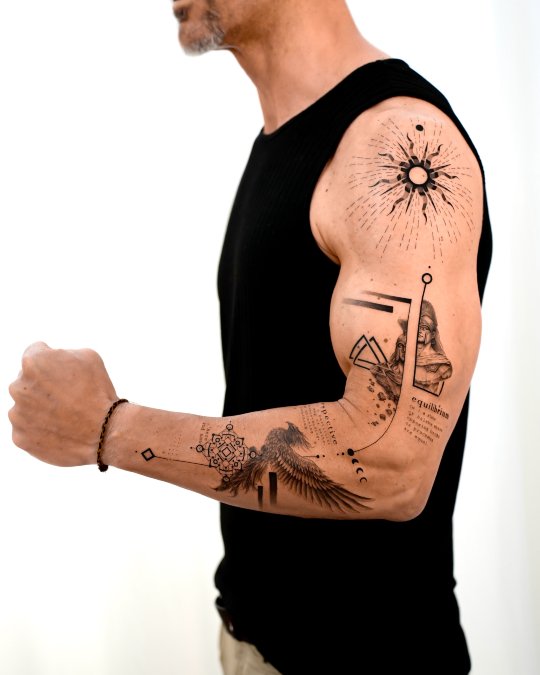
This sleeve runs from the shoulder to the wrist, built from separate pieces joined by thin lines. Each section uses a different style, and the white space between them keeps the arm from looking crowded.
- Shoulder: A bold black sun with wavy rays sits at the top, surrounded by fine dashed lines that fan out like light.
- Upper arm: Two helmeted warrior busts in soft grey realism sit beside black triangles and heavy horizontal bars. The word “equilibrium” and its definition sit just below.
- Forearm: A bird with spread wings and a geometric mandala sit side by side. Small text near the wrist reads “here and now,” and a diamond marker sits near the wrist.
- Connecting lines: A thin line with small circles, dots, and moon phases leads the eye from one section to the next.
This works because the design reads as one story even though the parts differ. The heavy black shapes balance the delicate realism, and the thin lines follow the curve of the arm. In this bent-arm shot, the pieces still line up around the elbow.
Ask your artist: Plan the full layout first, then book it in stages. A collage sleeve can grow one section at a time, but the connecting lines must be mapped out from the start so the pieces fit together.
Maintenance tip: The tiny paragraph text and fine dotted lines will soften first. Ask your artist to keep the type larger and the dots spaced apart, and use sunscreen on the shoulder, where the sun hits most.
Japanese Wave Sleeve
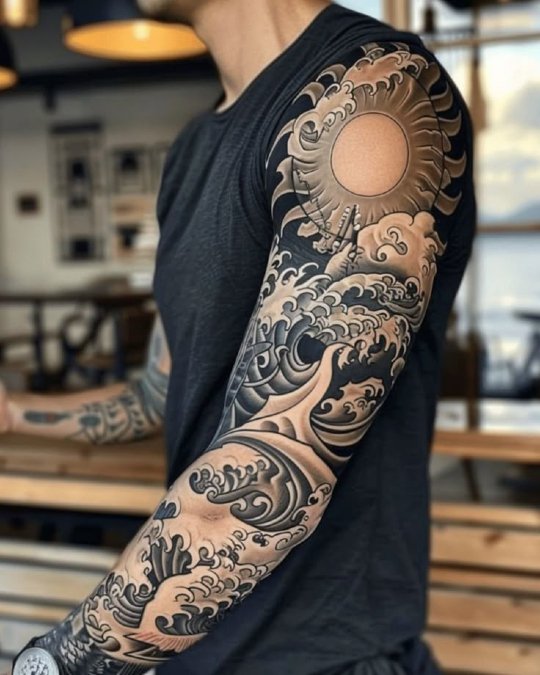
A full sleeve of rolling waves runs from the shoulder to the wrist. A large sun with pointed rays sits at the top of the shoulder, and the skin inside the circle is left unshaded. Curled foam crests and swirling water lines flow down the arm in black and grey.
The sleeve works because the open skin in the sun and the wave tops acts as a highlight against the dense black. The curved lines follow the shape of the shoulder, bicep, and forearm, so the design wraps the arm instead of sitting on it. Bold outlines keep the busy waves readable from a distance.
Best for: Men who want a large, cohesive sleeve with one theme from top to bottom.
Ask your artist: Bring references for Japanese-style waves and ask them to plan the flow around your arm. Leaving some skin open between the dark water areas helps the design stay clear as it ages.
Full sleeves usually take several sessions, so book the pieces in order, starting at the shoulder or the wrist.
Geometric Mandala Sleeve
Source: Insta
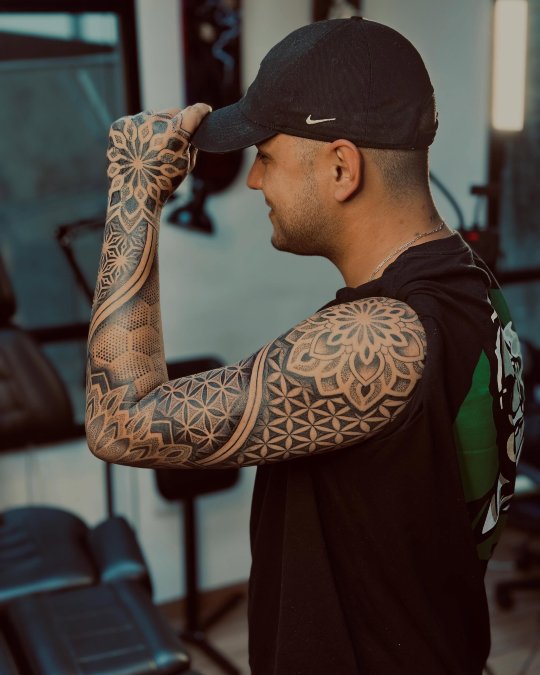
Tattoo formula: shoulder mandala + flower of life pattern + dotwork forearm + mandala hand
A full sleeve of black linework and dotwork runs from the shoulder down to the hand. A large mandala with layered petals sits on top of the shoulder. Below it, a flower of life grid of overlapping circles covers the upper arm and wraps toward the elbow.
On the forearm, the pattern changes to a star-like geometric design and a field of fine dots that fades from dark to light. Another mandala covers the back of the hand. Thin parallel lines curve around the arm and divide one section from the next.
The sleeve works because every section repeats the same circular, symmetrical shapes. The dotwork shading adds depth without heavy black fill, so the pattern stays open and clear on skin. The curved divider lines follow the arm, so each part looks planned for that section.
Maintenance tip: Dotwork and fine geometry depend on crisp spacing. Choose an artist with healed sleeve photos, and use sunscreen so the dots and thin lines stay sharp.
Best for: Men who like precise, symmetrical patterns and are ready to commit to a long, multi-session project. A hand tattoo is also highly visible and fades faster, so think about work and touch-up plans first.
Fine Line Patchwork Arms
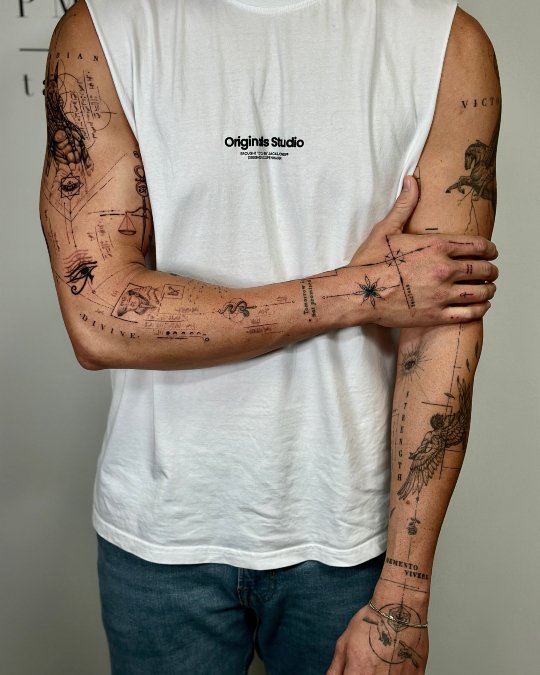
Both arms are covered in small, separate tattoos linked by thin lines, dots, and tiny symbols. The left arm leans Egyptian, with an Anubis figure, an Eye of Horus, an ankh, scales, and hieroglyph-style marks. A snake inside a circle and a curved “DIVINE” line sit near the elbow.
The right arm mixes a rearing horse, a sunburst eye, and a winged figure with a rose below it. Short phrases run through the pieces, including “Tomorrow is not promised,” “Strength,” and “Memento Vivere.” Two hands reaching toward each other sit on the wrist.
This style works because each piece has its own space. The thin connecting lines make the arms look planned, and the open skin keeps the mix of subjects from feeling crowded. It also lets you add one tattoo at a time instead of committing to a full sleeve.
Ask your artist: Keep the words large enough to read and check every spelling on the stencil. Very small text blurs first, especially on the forearm.
Maintenance tip: The finger tattoos fade fastest because the skin there renews quickly. Expect touch-ups on those, and on any fine detail near the hand.
Eagle With Compass Star
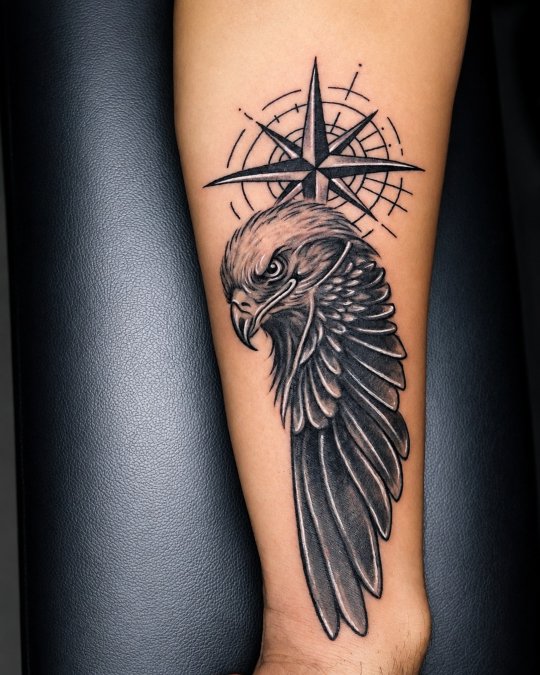
A bird of prey in black and grey sits on the forearm with its head turned to the left. It has a hooked beak and a sharp, narrowed eye. Its wing runs down the arm toward the wrist, with long feathers outlined in thin white highlights. Above the head, an eight-point compass star sits inside fine circles and grid lines.
Ask your artist:
- Top: Keep the compass star bold and dark, with the thin rings as light supporting detail.
- Head: Add strong contrast around the eye and beak, since these two spots hold the whole piece together.
- Wing: Let the feathers lengthen along the arm so the design follows its shape.
- Finish: Leave the white highlight lines open, because they are what make the feathers look raised.
The design works because the long, narrow shape fits the forearm. The star gives it a clear top, and the wing leads the eye down toward the wrist. Mixing a sharp symbol with soft shaded feathers keeps it from looking flat.
Maintenance tip: The thin rings and white highlight lines soften first. Ask your artist to space them well apart, and use sunscreen once it heals so the contrast stays strong.
Parent and Child Forearm Tattoo
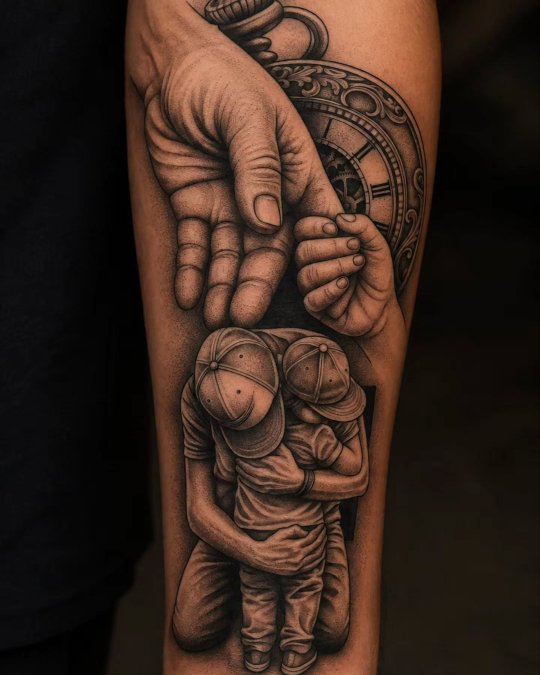
Large black and grey realism fills the forearm from top to bottom. At the top, an open adult hand reaches down, and a small child’s hand grips its thumb. Behind them sits an ornate pocket watch with Roman numerals, a ring at the top, and gears showing through the open face.
Below the hands, an adult kneels and holds a child in a tight hug. Both wear caps tilted forward, so their faces stay hidden.
Why it works: The stacked layout fits the long, narrow shape of the forearm, and the hands lead the eye down to the hug. A dark pocket of shadow between the hands and the figures keeps the skin tones in the hands from blending together. Hiding the faces under the caps also means the artist doesn’t have to capture a likeness.
The soft dotted shading gives the hands and clothing texture without heavy black fill. The watch adds a clear theme of time, so the piece reads as one story instead of three separate images.
Ask your artist: Choose someone with healed realism photos, especially of hands. Wrinkles and finger joints look wrong quickly if the shading is off.
Maintenance tip: Stippled shading and the thin scrollwork on the watch case soften first. Sun exposure speeds that up, so use sunscreen once it heals and plan a touch-up on the lightest areas.
Knee Mandala Leg Tattoo
Source: Insta
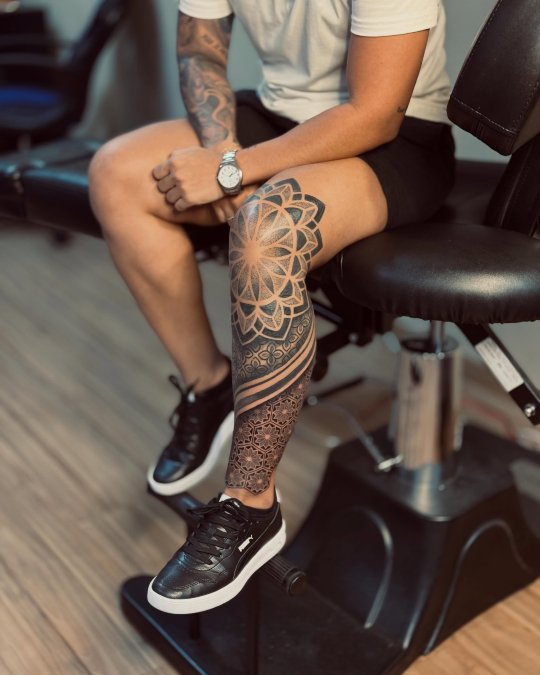
A large mandala sits on the knee, with layered petals in black linework and dotwork shading that fades from dark to light. Below it, a band of small flower shapes leads into curved parallel lines that sweep around the shin. The lower calf is filled with a honeycomb pattern of hexagons, each holding a small star-like flower.
Why this style works:
- Placement: The circular mandala is centered on the kneecap, so the round shape matches the round joint.
- Flow: The curved lines wrap around the leg and move the eye down, so the three sections read as one piece.
- Shading: The fine dots give soft gradients without heavy black fill, which keeps the pattern open and detailed.
Ask your artist: A knee is a tough spot, and the skin stretches and folds when you bend it. Ask about a stencil fitted while your leg is bent and then straight, so the mandala stays centered. Choose someone with healed dotwork photos of knees.
Maintenance tip: The thin hexagon lines and tiny dots can soften over time, especially on the lower leg, where socks and shoes rub. Use sunscreen once it heals, and plan a touch-up after a few years.
A Geometric Leg Sleeve
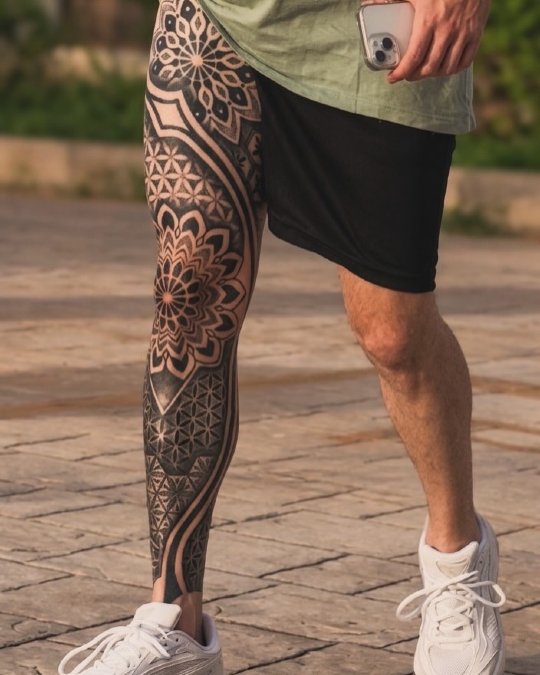
This black ink sleeve runs from the thigh to just above the ankle. The pattern changes as it goes down, but every section uses circles, petals, and repeated shapes.
- Thigh: A mandala with pointed petals peeks out above the shorts, with a solid black band under it.
- Knee: A large mandala with layered petals and fine dotwork shading sits at the knee, with a flower of life grid of overlapping circles above it.
- Calf: A dense star and flower pattern fills the lower leg and fades into lighter dotwork near the bottom.
- Sides: Curved parallel lines wrap around the leg and divide one pattern from the next.
The sleeve works because the long curved lines follow the shape of the calf, so the pattern looks fitted to the leg instead of laid over it. The solid black areas and the soft dot shading balance each other, which keeps the symmetrical designs from looking flat.
Ask your artist: Plan the sleeve as one piece, even if you book it in sessions. The dividing lines need to meet up cleanly from section to section, and the mandala should be centered on the kneecap when your leg is straight and when it’s bent.
Maintenance tip: The shin and ankle see constant rubbing from socks and shoes, and shorts leave the leg open to sun. Use sunscreen once it heals, and expect touch-ups on the lightest dot areas.
Interlocking Triangle Hand Tattoo
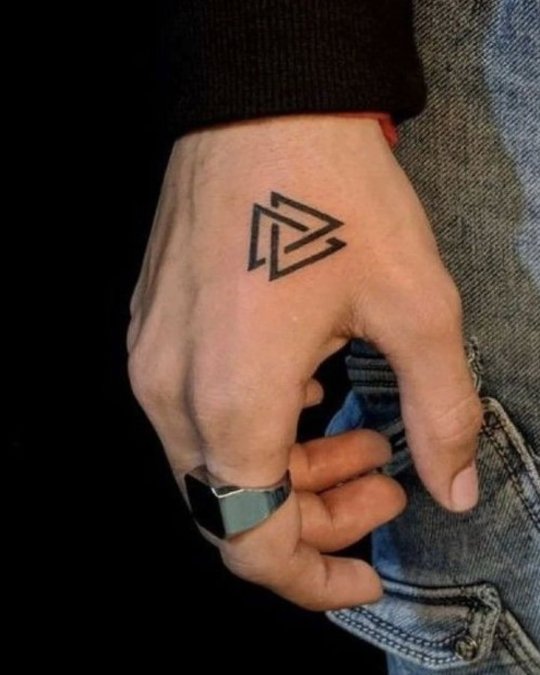
Two outlined triangles overlap on the back of the hand, just above the thumb knuckle. Each line weaves over and under the other, so the shape looks like a single linked symbol. The lines are black, even in width, and have no shading.
The design works because the clean geometry sits well on a flat area of skin. With no fill or fine detail, the shape stays easy to read at a small size. A square silver signet ring on the finger matches the sharp angles.
Easy upgrade: Ask your artist to add a third triangle or a thin outer circle. The design can grow later without changing what is already there.
- Line weight: Keep the lines slightly bold. Thin lines on the hand spread and fade quickly.
- Spacing: Leave clear gaps where the triangles cross. Tight overlaps can fill in as the ink softens.
Maintenance tip: Skin on the hands renews fast and gets constant sun, washing, and friction. Plan a touch-up within a few years, and think about work dress codes before booking a visible spot.
Rose Hand Tattoo With Faith Script
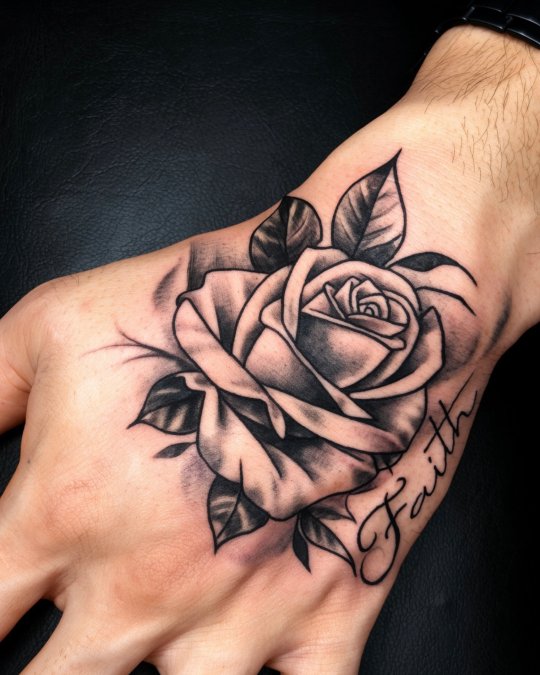
A large black and grey rose covers the back of the hand, with the bloom tilted toward the wrist. Bold outlines frame the petals, and soft shading builds depth in the folds. Several leaves with dark centers and light edges sit around the flower, and a few loose stem lines trail off to the left.
The word “Faith” is written in flowing cursive along the right edge, curving with the line of the hand. It sits close to the rose without touching the petals, so the flower stays the focal point.
Best for: Men who want a classic flower with a personal word, in a spot that is easy to show or cover.
The design works because the petals are left light and the shadows are dark, so the rose reads clearly even from a distance. The thick outlines also help it hold its shape on skin that moves a lot.
What to avoid: Keep the cursive strokes from getting too thin or too tightly looped. Hand skin renews fast, and slim script blurs before bold linework does.
Maintenance tip: Expect the soft grey shading and the script to need a touch-up sooner than a forearm piece would. Sun and frequent washing speed up fading, so use sunscreen once it heals.
Which Tattoo Idea Fits You? Quick Pick Guide
| Your goal | Ideas to look at | Why they fit |
|---|---|---|
| First tattoo, small size | #6 Latin Quote, #8 Sun and Moon, #5 Samurai Behind the Ear | Small designs, bold or simple lines, easy to place |
| Easy to cover for work | #6, #7 Lightning Shoulder, #8, #2 Back Wings, #17 Knee Mandala | A collar, sleeve, or pants hides them |
| Big statement piece | #9 Tiger Forearm, #12 Wave Sleeve, #13 Mandala Sleeve | Large designs that follow the shape of the arm |
| Personal meaning | #10 Clock Sleeve, #16 Parent and Child, #1 Winged Sword | Dates, words, and symbols that you can customize |
| Build it slowly over time | #14 Fine Line Patchwork, #11 Collage Sleeve, #7 Lightning Shoulder | You can add one piece at a time |
| Sharp geometric look | #13, #17, #18 Leg Sleeve, #19 Triangle Hand | Symmetry, dotwork, and clean lines |
Before You Book: 5-Point Checklist
- Placement first: Pick the spot before the design so the artwork can follow the body.
- Healed photos: Ask the artist for photos of tattoos that have healed, not only fresh ones.
- Spelling check: Read every word and date on the stencil before any ink goes in.
- Size for aging: Fine lines and tiny text need more room than most people expect.
- Work and life: Neck and hand tattoos are very visible, so think about dress codes first.
Tattoo Ideas for Men: FAQ
What is a good first tattoo for a man?
A small, simple design is the safest start. A short word, a small symbol, or a bold shape like the sun and moon works well because it is easy to read and easy to cover.
Which tattoo placements usually hurt more?
Areas with thin skin or little padding, such as the neck, hands, and knee, often feel sharper than the outer forearm or shoulder. Pain varies from person to person, so ask your artist what to expect.
Do fine line tattoos fade faster?
Yes, thin lines and tiny details usually soften sooner than bold black areas. Sun exposure speeds this up, so use sunscreen after the tattoo heals and plan for a touch-up.
How long does a tattoo take to heal?
The surface usually heals in a few weeks, but the skin underneath takes longer. Follow your artist’s aftercare steps and avoid soaking the tattoo or picking at it.
Can I build a sleeve one piece at a time?
Yes. Ask the artist to plan the full layout first, then book it in stages. Patchwork and collage styles are made for this because each piece stands alone.
Final Thoughts
A good tattoo comes from three things: a design you still like later, a placement that suits the artwork, and an artist whose healed work looks sharp. Use the ideas above as a starting point, then bring a few references and ask for a custom version that fits your body.
Save this list for your next artist consult, and take your time choosing. The best tattoo is one you plan well.
Tattoo Ideas for Men: Frequently Asked Questions
What is a good first tattoo for a man?
Start with a small, simple design. A short word, a bold symbol, or a sun and moon is easy to read and easy to cover. Small pieces also let you learn how you handle the process before committing to something bigger.
Which tattoo placements usually hurt more?
Thin-skinned or bony areas like the neck, hands, ribs, and knee tend to feel sharper. The outer forearm and shoulder are often easier. Pain differs from person to person, so ask your artist what to expect.
Do fine line tattoos fade faster?
Usually, yes. Thin lines and tiny text soften sooner than bold black areas. Sun exposure speeds this up, so use sunscreen once the tattoo has healed and plan for a touch-up.
Which tattoo styles age best?
Designs with bold outlines and solid black areas tend to hold their shape longest. Realism and dotwork can age well too, but they depend on strong contrast and a skilled artist. Ask to see healed photos of the same style.
How do I choose the right placement?
Pick the spot before the design. Long designs like wings or lightning suit the shoulder, back, or forearm, and round designs like mandalas suit the knee or shoulder cap. Your artist can fit the stencil to your body.
Can I get a neck or hand tattoo and still work a normal job?
Many people do, but these spots are always visible. Check your workplace dress code first. Hands and neck also fade faster, so expect touch-ups.
How do I make sure the text and dates are correct?
Read every word, number, and date on the stencil before any ink goes in. Ask a friend to check it too. If the text is in another language, confirm the spelling with a native speaker.
Can I build a sleeve one piece at a time?
Yes. Ask your artist to plan the full layout first, then book it in stages. Patchwork and collage styles work well for this because each piece can stand alone.
How should I look after a new tattoo?
Follow the aftercare steps your artist gives you, since methods vary. In general, keep it clean, avoid picking at it, and keep it out of the sun while it heals. If it looks infected, see a doctor.
How do I find a good tattoo artist?
Look for a portfolio with healed work, not only fresh photos. Choose someone who specializes in the style you want, such as fine line, realism, or geometric. A clean studio and clear aftercare advice are also good signs.
Should I copy a tattoo exactly from a photo?
Use photos for style and mood, then ask for a custom version. Size, skin tone, and placement all change how a design looks. A tattoo made for your body will age better than a direct copy